I’ve started a new blog to record a series of essays I wrote during my stay in Canberra, Australia in 2007:
http://expatbobinoz.blogspot.ca/
Bob
Friday, 9 May 2014

Friday, 2 May 2014
The Souks of Dubai
 |
| The Dubai Spice Souk |
Gold, frankincense and myrrh; the magic of
the Middle East must surely be found in its souks (markets). There are several
in Dubai, each specialising in different commodities. We’d gone to the Gold
Souk first, which deals in jewellery, watches and some clothing – these stores
seem to be operated primarily by Indians, Pakistanis and Sri Lankans and you
are expected to bargain when you buy. I go for gold jewellery (no surprise if
you know my wife): first they weigh the piece, tell you the current price of
gold and give you a price. Then you bargain – ‘that’s more than I wanted to
pay!/what did you want to pay?/etc… I manage to get my guy to cut 30% so I feel
good, whether I should or not…
 |
| In the Gold Souk, Dubai |
I followed him through a maze of little
alleys and finally got to a door where an old man stood. The old man ushered me
in and up some stairs, looking left and right as he went. Then we reached
another door and he flung it open and disappeared. Inside was a young guy
surrounded by ‘knock-off’ items – no Harley stuff though. It was then that I
realized my guide had mistaken ‘Harley Davidson’ for a luxury brand. So, I
bought a Louis Vuiton purse for $25 (£15)…!
 |
| Spices in store |
 |
| Looking through Dubai's Textile Souk |
Finally, the Textile Souk, which you reach by boat taxi (abra) across Dubai Creek – the most fun you can have for 1 Dirham (25c / 20p) the guidebook says – and it’s true. Passengers cram on one side or the other and head out, rocking from side to side, between huge aging dhows loading goods from the wharf – their crews waving as you pass.
The Textile Souk is housed in shops that
open onto a cobbled street. The vendors are more aggressive here and call to
invite you in and try a gown, scarf or sandals from the brightly coloured
embroidered cloth that fills the street.
There are souks all over UAE but the ones in Dubai around its creek seem the most intriguing… All you have to worry
about is bringing your purchases home!
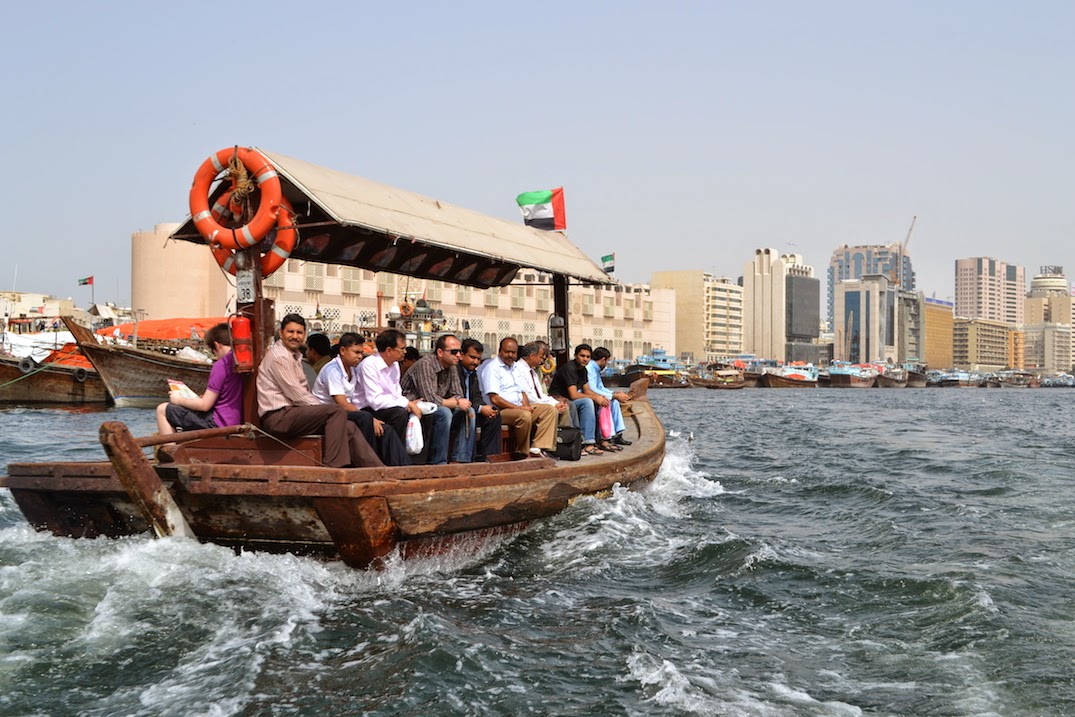 |
| Aboard an Abra crossing Dubai Creek |
Friday, 25 April 2014
Dress Code
A colleague and I were visiting Dubai in
July – he wanted to dip in the Arabian Gulf so we parked and walked across the
sand. It was midday and hot. As we got to the beach, and he ran into the water,
I noticed a couple walking towards us on the otherwise deserted beach. They
were obviously European and, I supposed, in their forties; the guy had a golf
shirt and slacks but the woman, a diminutive, plump, redhead, was bursting out
of a string bikini.
“Lovely weather for a dip,” she said,
followed by the inevitable: “Where are you from?” She offered that they were
from Devon. “We always come to this beach,” she said, “the other beaches are
full of guys ogling you – I never feel comfortable there,” oblivious to the
fact that her behaviour may have contributed…
Dubai, Abu Dhabi and the UAE in general are
populated primarily with men. There are a number of Emiratis and some
Westerners but more than half are East Asians working to send money home – they
can’t afford to have their families here.
 |
| Shopping at a rural festival souk |
Modesty is the watchword in UAE. A local
guidebook ‘Ask Ali’ (link) states that locals dislike immodest dress but tolerate it,
as long as it’s restricted to the beach.
Local men all wear the full-length shirt
(robe), the kandura (thawb in Saudi Arabia, dishdasha throughout Middle East), generally white, although other colours are seen (lemon, lime and even black).
They always cover their hair with a scarf (keffiyah), which in UAE is also
generally white. For formal wear (e.g. working in an office) it is draped over
the head and kept in place by an agal (black cord). For casual wear the
keffiyah is wrapped around the head like a turban. Several guys I spoke to said
that they’d be sent home from work if they weren’t wearing their keffiyah with
an agal. The other common keffiyah colour is a red and white check.
 |
| Mohamed in kandura, keffiyah & agal |
Under the kandura, men wear underwear and
generally they wear sandals (no socks). But when it’s really cold, they wear
socks and western-style shoes. You never see Emirati men in Western clothes,
unless they are outside the country.
Emirati women wear black. A full-length,
light, black gown, an abaya, covers their arms and legs. Under this gown, they
tend to wear Western clothes; the trendier girls wear designer jeans and name
brand high heels. But even their abayas are exclusive (Chanel, Dior, etc.);
despite being black they are adorned with gold patterns or quilted sleeves.
This is worn with a matching scarf (shela), a light, loose, black cloth often
adorned to match the abaya.
 |
| Trendy Abaya & Shela | Hijab | Niqab | Shela as cover | Bedouin Burqa Note: Carol illustrates some of these - it’s improper to photograph women |
The chic Emirati’s, particularly in
downtown Abu Dhabi and Dubai wear their shela so that the front of their hair
shows. The more devout wear a hijab, a scarf pulled tightly around their hair
to conceal all but their face. Out in the suburbs it is more common to see
women wearing the niqab; combined with the shela this covers their hair and
face leaving only the eyes. Surprisingly, it’s still possible to recognise
someone when you can only see his or her eyes. Try it!
Occasionally, you’ll see women with their
shela draped over their head completely covering their hair and face. In the
various rural communities where we’ve attended festivals most local women wear
the traditional mask-like Bedouin burqa.
Although most beaches are open to all, in
order to protect the modesty of women, some beaches are designated ‘family’
beaches. Men can only access these areas if accompanying women and children.
And, it is an odd sight to see young Western women in their bikinis alongside
local women dressed from head to toe as their children play together in the
sea.
 |
| On the beach at Dubai |
Friday, 18 April 2014
The Pillars of Islam
The UAE is an Islamic country and Emiratis
follow the five pillars of Islam:
 |
| Grand Mosque Chandelier - Muscat |
1. Acceptance that there is only one God,
Allah, and Muhammad is his messenger
2. To pray five times a day
3. To give alms to the poor
4. To fast during the 30 days of Ramadan
5. Make a pilgrimage to Mecca, once in a
lifetime (the Hajj), if you are able
Living in the UAE, the proclamation of the
first pillar is heard in the Adhan (call to prayer) as it permeates the air
five times a day. In the community where I lived there was a constant battle
over the volume of the Adhan from our three mosques, particularly the pre-dawn
call, before 4:30am in summer, which some claimed destroyed their children’s
sleep.
Muslims pray five times a day, often in the
mosque but almost anywhere will do. Worshippers must face Mecca (a direction
called Qibla); there are Smart phone Qibla apps and each hotel room has a
little arrow on the ceiling or in a bedside drawer. What I didn’t realize when
I offered my Calgary office as a prayer room for a couple of visitors was that
they cannot pray in the presence of human or animal likenesses. I’d removed all
my family photos, marked the Qibla on the floor, and provided mats but they
wouldn’t use the room – only afterwards did I realize it was my large concrete
sheep (don’t ask!) and Welsh rugby dragon that had stopped them.
 |
| Grand Mosque Ceiling - Muscat |
The lack of figurative art has created a
unique approach to the inside of mosques. This has focused Islamic artists on
three levels of art: Geometric patterns, often expressed with ceramic tiles,
Arabesque which employs depictions of plant life and finally, Calligraphy, seen
as the highest art form, being the depiction of God’s word from the Qu’ran
(Koran).

Alms is payable as a percentage of assets
owned. There are agencies that exist to collect this annual tithe. Muslims
believe that they are answerable to God for their treatment of the poor and so charity
is a fact of life. There are clearly defined groups eligible to receive alms
other than the destitute and it includes the payment of ‘blood money’ on behalf
of those that cannot afford to pay it (see previous blog).
 |
| Arabic Calligraphy - Grand Mosque Abu Dhabi |
Fasting during Ramadan, the Muslim Lent, is
intended to focus believers on their own actions and the plight of the poor.
Emiratis eat at around 4am, before the first prayer of the day, and don’t eat
or drink again until after 7pm when they break the fast with Iftar.
My friend Mohamed invited me to take Iftar
with him and his brothers during Ramadan at his house. Emiratis eat sitting on
the floor and the meal was laid out on the elaborate carpet over a plastic
tablecloth. When you’ve spent your life eating on the floor it’s easy but when
you are over 60 and only had the occasional picnic it can be a struggle. Mohamed
insisted I sit on a cushion but getting comfortable down there was only half of
it. They eat with their hands, so I had to lean forward and support myself as I
grasped lamb biryani (rice and lamb) and attempted to get it to my mouth. The
food was delicious though.
It seemed that almost everyone I met had
completed his or her Hajj; it’s a short distance from Abu Dhabi to Mecca in
Saudi Arabia, close to Jedda. The local airlines stage Mecca Specials. I’d
always thought you could go on your pilgrimage whenever you wanted but no, Hajj
takes place on specific days of the 12th month (Al Hajji) and follows a specific
schedule, so all of the attendees are moving in a single mass through the each of the rituals.
Non-Muslims are forbidden from entering the
holy city of Mecca and the penalties are quite severe so I imagine I’ll never
get invited there!
 |
| Mosque at night - Muscat |
Friday, 11 April 2014
Muscat Accidental
A friend of Carol’s was in UAE on a
visitor’s visa; these are only valid for two months; you need to leave and
re-enter the country in order to renew it. So, she invited Carol to fly to Muscat,
Oman for the day (less than an hour’s flight), and off they went. This is
Carol’s account of that day…
 |
| Sultan Qaboos |
We landed in the city of Muscat on a Monday
morning in November, thinking that it would be a regular mid-week, mid-winter
day. We’d wander around, see the sights, buy a few trinkets and partake in a
couple of relaxing meals, then head home. We didn’t realize that it was
Monday the 18 November – National Day in Oman.
National Day celebrates the succession of
Sultan Qaboos to the throne in 1970, when he deposed his father and ushered
Oman into the modern age. Just like UAE, locals dress up their vehicles with
pictures of the Sultan and head to the beach in their hundreds….
 We arrived in the city around 10:00 and took a walk through a souk full
of ethnic clothing and spices. As we only had a day we decided to take a Big
Bus tour (on a red double-decker bus) – the city is quite spread out. We got
off at the third stop for lunch then got back on to see the sights. We boarded
the bus thinking we would go two stops to see the Opera House, but along the
beach road we saw lots of cars ahead and realized that they were celebrating
the 43rd anniversary of Oman's creation.
We arrived in the city around 10:00 and took a walk through a souk full
of ethnic clothing and spices. As we only had a day we decided to take a Big
Bus tour (on a red double-decker bus) – the city is quite spread out. We got
off at the third stop for lunch then got back on to see the sights. We boarded
the bus thinking we would go two stops to see the Opera House, but along the
beach road we saw lots of cars ahead and realized that they were celebrating
the 43rd anniversary of Oman's creation.  Cars decorated in flags and silkscreen graphics of their leaders soon
surrounded us. After about half an hour the driver asked if anyone would mind
missing stop four as we could not get through; we were stuck with cars parked
everywhere. We had a great view from the top deck of the bus and were enjoying
the absolute chaos around us but agreed it was better to get away and continue
the tour. The only problem was turning a double decker bus within two lanes
that were chock-a-block with cars! It took a while but eventually we were on
our way.
Cars decorated in flags and silkscreen graphics of their leaders soon
surrounded us. After about half an hour the driver asked if anyone would mind
missing stop four as we could not get through; we were stuck with cars parked
everywhere. We had a great view from the top deck of the bus and were enjoying
the absolute chaos around us but agreed it was better to get away and continue
the tour. The only problem was turning a double decker bus within two lanes
that were chock-a-block with cars! It took a while but eventually we were on
our way.  |
| Turning the Bus |
We decided we deserved a drink (or two...) so went to a
hotel for dinner; we enjoyed a good meal and some wine. As we got the bill, an
Arabic man appeared next to me. He introduced himself and said he would like to
pay our bill. We refused, but he explained that I looked just like his mother
and he really wanted to pay. I couldn't see how - I (strawberry-blonde, white
and freckled) could possibly look like this man's mother but told him I was
pleased I’d reminded him of this very important person in his life but could
not accept the offer.
We paid and made a hasty retreat with a final wave and goodbye to my
phantom son. Traffic was still a challenge but we made it home safely after a
long adventurous day.
 |
| Family Play at Sunset - Muscat |
Sunday, 6 April 2014
Blood Money
Justice is different in UAE. As I might
have said previously, you take your life in your hands when driving here – fast
cars and aggressive driving make accidents common. Fortunately, we escaped
unscathed!
If you are involved in an accident, you’re
obliged if you can to move your vehicles off the road as soon as possible – or
you risk a fine for impeding the flow of traffic.
 |
| The Fire Chief’s Corvette; Dubai Police drive Lamborghinis |
The police arrive, make an assessment, and assign
guilt to one of the parties. Every police officer carries a pad for just such
occasions – it has three sheets: one red, one green and one white. If you
receive the red sheet, you’ve been deemed guilty; if you receive the green one,
you’re off the hook, the white one stays with the cop. And, you can’t get your
car repaired without presenting a copy of the red or green sheet.
Drinking and driving? You can expect to be
arrested, charged and eventually deported. Penalties will be higher if you
didn’t have a liquor license.
If there are injuries though, life gets a
little more complicated, especially when it’s determined that you are at fault
– even if it’s an accident. Under Sharia law, the injured party is assessed for
disability, caused by the accident, and you are charged ‘blood money’ for the
degree of disability (loss of limb, eye, etc.), similar to assessment of
damages in the west.

In the case of death, under UAE law, a
man’s life is valued at $60,000 (£40,000). A recent
case saw a truck driver, who had caused an accident that killed 21 people,
fined and jailed for the offence but in addition was ordered to pay a total of
$1.2M (£840k) in blood money (or Diyya) to the victims families (link to article). Clearly this is beyond his means
on a wage in the order of $1,000/month and often someone will step in and pay. It could be his employer, a charitable fund
set up in his home country, or the generosity of an Emir, the latter usually an
act coinciding with Eid or National Day celebrations.
 |
| Sharjah Minaret |
It’s more complex in the case of someone
convicted of murder. In UAE, persons convicted of homicide are usually sentenced
to death. But, before the sentence can be carried out, the victim’s family is
consulted. They can agree to the execution or request the payment of Diyya and
an accompanying pardon for the offender.
The Qur’an preaches forgiveness rather than
retribution so Muslim families, at least, are encouraged to absolve the felon
and settle for Diyya. To seek revenge may be viewed as assuming the power of
God.
Where it gets really difficult is when the
authorities are unable to trace family members. It’s a challenge at the best of
times with expats (offshore, non Emiratis) comprising more than 80% of the UAE
population. In this case, the court acts on behalf of the family, but they are
not empowered to uphold the death sentence. Many convicts sit on death row for
years as they wait for their victim’s family to be found (link to article).
So, I encourage everybody to drive
carefully…
 |
| Tree at Dawn |
Subscribe to:
Posts (Atom)