Friday, 1 November 2013

Petra, Jordan - Out Through the Mountains

The Monastery - last glimpse

“Are you afraid of heights?” We all answered ‘No…,’ as our guide planned the end of our tour. “In that case, we’ll hike out the far side of Petra and through the mountains. Someone will pick us up on the road at the other end and drive us back to the hotel.”

Scree covered ledge
It’s hot and dry – don’t venture out without water, we were told. So, I bought two bottles at the Petra site from the Capt Jack Sparrow twins’ cafĂ© – well, that’s what we called them – their young swarthy faces capped with tight Arabic headscarves and their eyes traced top and bottom with black khol (eyeliner). They looked the image of the Johnny Depp pirate. So much so that I copied the look for Halloween (...as the good Captain’s grandpa, Carol said)!

We left the Monastery* and headed away from Petra along a mountain path, climbing at times steeply, at times along precipitous narrow ledges, a sheer drop to one side. And, sometimes we scrambled up loose, scree-covered hillsides. It was late afternoon; shafts of sunlight cut through the ridges, throwing valleys into deep shadow. We came upon the foundations of Neolithic buildings. Why would anyone live up here? To safeguard themselves and their families; to be found was instant death.
Local Shop-Owner (silhouetted)

From time to time, Abdullah would call out; usually the response was an echo but once someone high on a mountaintop above us called back …and the two of them had a conversation. Oh, he’s a friend of mine; he lives up there. What does he do? He runs a shop! You’d hike miles from civilization, it seemed, and you’d struggle round a rock to find someone offering tea and selling local trinkets. But today, other than this guy, we came across no one.


Like all good guides, Abdullah made our trip memorable; our favourite was when he lined us up on a mountain ridge with the sun behind us for a photo; only when we saw the picture did we realize we’d become the ‘evolution of man’ poster. Good job we didn’t know what he was doing or we may have questioned the order of the line-up!

The March of Humanity?
Disturbingly, two hours into our hike, he got on his cell phone to arrange our lift home… And, as we climbed, we could see for miles, but there was no sign of any road. As the sun disappeared behind a peak, we started to question how far we’d have to walk. ‘Not far now,’ was always his response.

Eventually, with the light fading quickly, we clambered up to a dusty plateau. There was our vehicle – a battered Isuzu pick-up truck. All nine of us, four in the flatbed and five inside, squeezed in. Then we drove off; this wasn’t a road in any traditional sense. The track had deep holes and was strewn with rocks; at times it disappeared. As with our hike, the truck edged along ledges, slid down slopes and occasionally seemed to hang motionless for no reason. The driver and our guide talked, laughed and answered their cell phones without a pause as the vehicle lurched from side to side. We drove like this for more than 30 minutes, passing the occasional Bedouin tent or lighted cave; reminding us that yes, people live here. It was dark before we reached a real road and finally, the hotel. On the mountain many of us had said: ‘Wow, when I get in that vehicle, I’ll be asleep in seconds’, but, none of us were able to remain still long enough to doze.

That was Petra! Next day, we went back for more…
Petra - Late afternoon mountain vista
* The Monastery is described in my last blog: Petra Jordan Rose Red City of the Nabateans 

Saturday, 26 October 2013

Petra, Jordan – Rose Red City of the Nabateans


Treasury - first glimpse
Like Indiana Jones*, or more like his father, I descended into Petra through the Siq (Seek). This sunken pathway snakes through a gap in the rocks, at times more than 150 metres (500 feet) deep, for over a kilometre. And for most people, it’s the only way in or out. As you reach the end, you catch a glimpse of the Treasury, a Greco-Roman building from 2,000 years ago. But you realize this is no ordinary historic structure; like all of the buildings in Petra, this façade was carved out of the rock where it stands – no assembly required. Petra was largely constructed by the Nabateans, but eventually the Romans conquered and modified the site adding their own structures.
Wall colours - Silk Tomb
Unlike Indiana, you cannot enter; apparently, there’s not much to see in there, and at first sight it looks like this is it – this one magnificent façade is Petra. But, turn to the right and walk along another Siq and a breath-taking world opens up – one full of beautiful facades, hundreds of them, amphitheatres, long staircases and coloured caves. The dramatic vista of Petra is huge and unique.

Abdullah, our Petra born and raised guide, pointed out details, explained the history, and set rules – what was good to buy, where to use donkeys, how to deal with the locals, and how much to pay (not much!) – and it seemed everyone knew him – it made us feel oddly connected. And, he had good advice: “You’re going to get a lot of people offering horse rides, silver bangles, postcards… Don’t say ‘maybe, on the way back, or later’ they’ll see that as a promise… …just say No”.
Young entrepreneur
But, we all bought something – the children selling stuff were just too cute, and polite.

We climbed the more than 800 steps to the Monastery, on the donkeys Abdullah negotiated for us; some stretches seemed almost vertical. My donkey just jogged up, going right to the edge of precipices. I held on for dear life, partly because my saddle wasn’t quite tight. And, frankly, shouting at me to sit up straight didn’t help!

The Monastery

The Monastery is a huge façade; it's large interior and the level plaza it dominates were all cut from  solid mountain. A set of steps lead up to the top but these have been walled off after several tourists fell or jumped to their deaths… Still, you can see guys scramble to the top of the urn. But, that’s Petra – the amphitheatre is fenced off, but we saw a group of tourists pull back the fence to get in – a local guy was helping them. 


Coffee at 7am
There are cafĂ©’s along the way, run by local Bedouin who live there. On a cool, early morning photo hike, a guy called out ‘tea or coffee?’ and we went in. It was only then I realized that behind the canvas awning the cafĂ© was a cave. And like many of the tombs, in fact, even the washrooms, the patterns on the rock are stunning.

I discover how fortunate we are to visit this site now; before the Arab Spring, Petra saw 5,000 to 6,000 visitors a day; now it’s more like 500 a day, a tenth of that. And in the early morning (6:30am), it was deserted, save for the locals, and their animals.

Abdullah guided us up from the Monastery across the relatively tortuous mountain route, but that’s a story for the next blog...

Our highly recommended guide: https://www.facebook.com/abdullah.h.nawafleh
 or https://www.facebook.com/TourInJordanPetra

*Petra features in the movie Indiana Jones and the Last Crusade.

Royal Tomb Facades - Petra

Sunday, 20 October 2013

It's Eid


It’s Eid. ...No, not Eid Al Fitr (Eed Al Fitter); that’s at the end of Ramadan…

This week is Eid Al Adha (Eed Al Ad-da) that marks the end of Hajj, the annual pilgrimage to Mecca.

Eid Lights
Both Eids are celebrations and hold a lot in common. Everyone buys new clothes, and children in small, tight-knit communities still go door-to-door asking for money; (modern city kids just get a cheque from their Aunt or their Granddad). Mostly, it’s a grand feast after fasting; a time for family, overeating, TV specials and sales at the big stores. Multi-coloured lights fill the streets and malls.

Hajj lasts several days and is the time once a year when more than 3 million Muslims descend on Mecca to conduct the ritual.

New Clothes can hurt!
One of the Five Pillars of Islam, performing this pilgrimage to Mecca is mandatory for all who are able, once in their lifetime. The Hajj follows a prescribed path over several days within the city of Mecca, Saudi Arabia, following the trials of Hagar, Abraham’s second wife and their son, Ishmael, and ends with Mount Arafat Day, a day of fasting. The rituals of Hajj culminate with Abraham’s ultimate act of obedience to God when he obeys the order to sacrifice Ishmael. At the last moment, God produces a lamb as a substitute.

So, unlike Eid Al Fitr, Eid Al Adha commences with a ceremonial sacrifice.

The head of all Muslim families, whether attending Hajj or not, sacrifices an animal, usually a lamb or a goat, sometimes even a camel. This is then eaten at their Eid Al Adha feast, a meal held with their family, but at least a third is given to charity, either to feed the local poor or sent to other struggling communities, refugee camps, etc., in countries across the region. 

Amman, Jordan - Sheep Pen on Eid morning
In UAE, people purchase their sacrificial lamb a few days before Eid and, if they have room, tether it in their yard. On the morning of Eid, a butcher comes over and slaughters the animal. If they don’t have room, they go to the slaughterhouse (by all accounts, slaughterhouses are bedlam during the day of Eid), to find an animal and have it prepared.

We were in Jordan, a more traditional society, and we drove out of Amman, the capital, and into the countryside early on Eid morning. Street corners all along the way had small temporary pens of sheep or goats. Guys were all jostling around to choose their animal – it was just like they were picking out their Christmas Tree. To one side, a butcher waited to slaughter, bleed, skin and prepare the animal, on the spot.

Coincidentally this year, Eid Al Adha occurred the day after Canadian Thanksgiving, where families also got together to eat too much, play silly games and upset each other, over a sacrificial turkey...

Eid Mubarak! (That’s Happy Eid)

For more information on the traditions of Hajj & Eid Al Adha: http://en.wikipedia.org/wiki/Hajj
Grand Mosque at night


Saturday, 12 October 2013

Visiting the Sheikh Zayed Grand Mosque


Ken & I approach the mosque from the parking lot, walking across the deserted courtyard. We haven’t seen a visitor’s entrance or signs for it and I’m feeling nervous; mosques are generally forbidden to non-Muslims. Suddenly, a guard appears, shouting at us and gesturing furiously for us to move. We move, and as soon as we do, the contents of a bucket of water hit the floor, right where we’ve been standing. The guard runs up apologizing: “They’re cleaning the minaret & I saw the water coming down on you,” he says.

Pillars surround the Courtyard
‘Are we OK here?’ I ask.
“There are only three rules: if you go inside the Mosque, take off your shoes; if you see any books, don’t pick them up – they’ll be the Qur’an – even us Muslims don’t touch them until we’ve done our ablutions; and, Sheikh Zayed’s grave is at the side of the mosque; please don’t take pictures of it.”

Sheikh Zayed was the driving force behind formation of the UAE over 40 years ago and the founding father of the Mosque; the first ceremony here in 2004 was his funeral. He conceived this Mosque for worship but also as a place to share understanding of Islam by welcoming visitors of all faiths.

…The guard might have added; ‘and, if you are a woman, you must cover your arms, legs and hair.’ We went inside.

The Garden Vines - detail
The courtyard is huge – the mosque can accommodate 40,000 worshippers and often does during Ramadan – the surface is inlaid with large flowers and is surrounded by white marble columns bearing semi-precious vines, reminiscent of palm trunks topped with gold leaf. 

Inside The Garden
On each corner is a minaret. Our guide explains that the muezzin used to climb the minaret and cry out the adhan (call to prayer) five times a day. “But, thanks to God for Sony, only the cleaners climb up there now...”  But, It is the most exotic sound – we hear it every morning from the mosque beside our house, starting at 4:30-5:00am depending on the time of year; listen: http://www.youtube.com/watch?v=mUHDYlJHaOQ

Removing our shoes and leaving them in the courtyard, we enter through The Garden, an entranceway with walls of climbing vines set in relief; semi-precious stones in gleaming white marble, reflecting the designs on the courtyard pillars. You just have to touch the flowers...

The 99 Names of Allah - detail
Men's Prayer Hall
This leads into the largest room in the Mosque, the Men’s Prayer Hall – and this room is breathtaking, containing the world’s largest carpet, laid beneath the world’s largest chandelier. Worshippers face the 99 Names of Allah (the avenger, the pardoner, the giver of life, the bringer of death, the first, the last, the all powerful, the gracious, the King…). The room is broad, so broad our guide tells us that they only use it during major events such as Ramadan; the main prayer room itself can accommodate 7,000 worshippers; and they pray side by side, in a line, only starting a new line when the first one is full. The carpet has lines weaved into it to guide worshippers.


Women's Prayer Hall - carpet detail
showing prayer lines
During normal prayer times, the men use one of the two much smaller Women’s Prayer Halls. The one we enter has been constructed with an intricately carved ceiling that reflects the patterned carpet. I try to imagine how many thousands of hours it took to create.

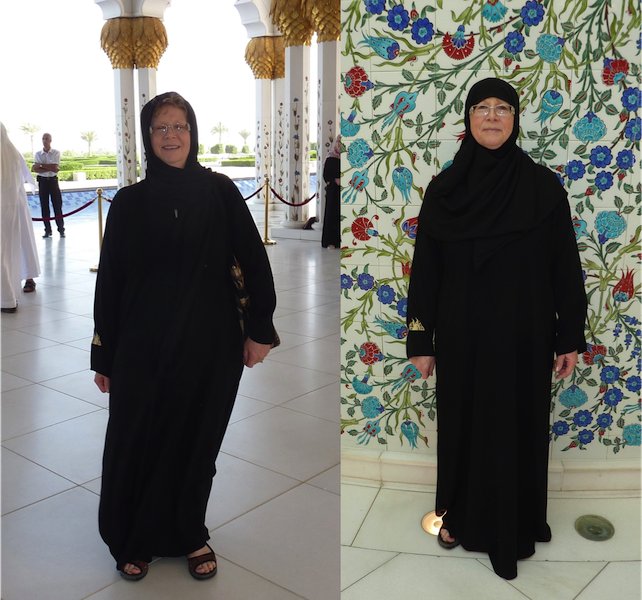
Carol (before and after)
When Carol visited, she put on the black abaya (gown) and shelagh (headscarf) provided at the visitors entrance; she lightly wrapped herself as most Emiratis, and mosque visitors do, but on a visit to the washroom was helpfully re-dressed, in a more devout style, by a local worshipper.

The Mosque is a dazzling sight; perhaps the most beautiful building I’ve ever seen. I’ve lost count of the number of pictures I’ve taken of it…

Woman's Prayer Hall ceiling detail